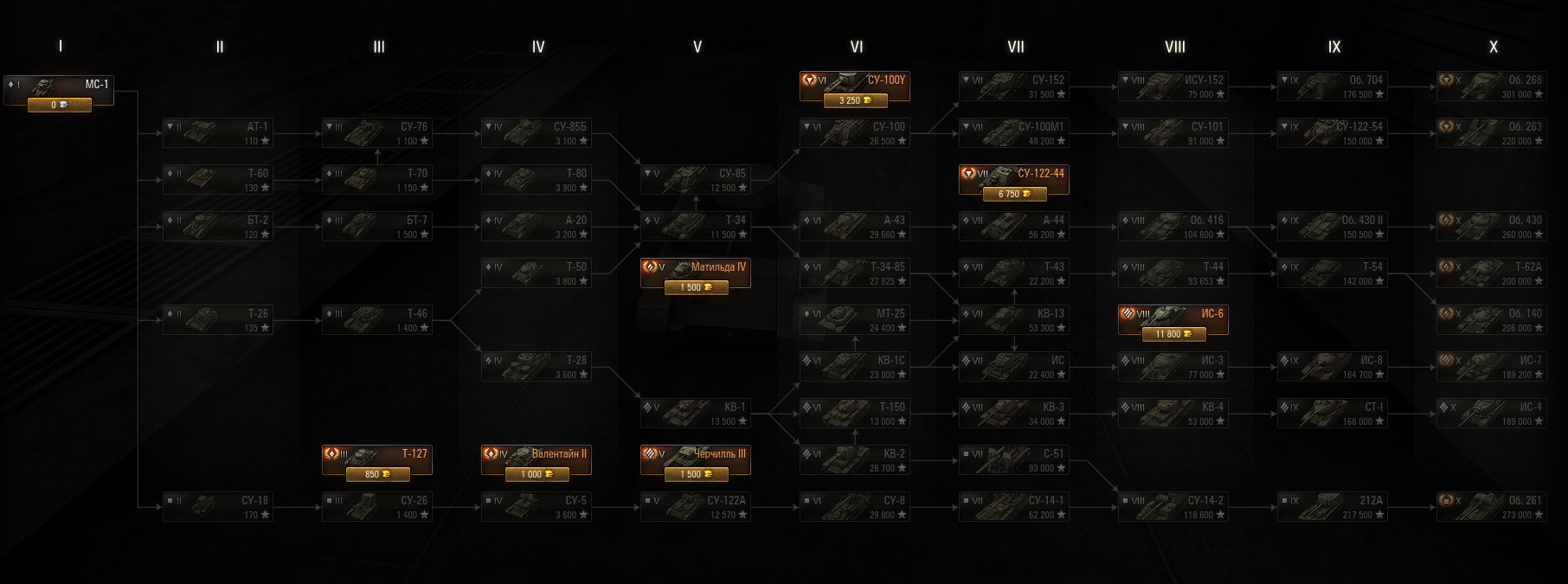
Wargaming’s “legendary tank” turned out to be the KV-220. How appropriate that a “legend” should be worthy of what today’s hip youth would describe as an “epic fail”. First, some background.
The KV-220 (otherwise known as KV-220-2, T-220, Object 220, or just 220 in factory documents) was proposed in 1940, as a replacement for the KV-1 that was already considered inadequate by the Red Army. The T-150 was ordered in the same document. The T-150 was meant to have a 700 hp engine and KV-220 an 850 hp engine, but problems were encountered in building such powerful engines. By May of 1941, the KV-220 only had a V-5 engine turbocharged to 700 hp. The in-game T-150 gets that engine under the index V-5F (“forsirovanniy”, turbocharged). You’d think that the KV-220 would get its 850 hp engine too, right? Or at least the 700 hp one? Nope! It gets…650 hp. That’s kind of a downer, seeing as how the tank isn’t exactly tiny, and an extra 200 hp (or even 50 hp) would have come in handy.
The KV-220 and T-150 didn’t meet the Red Army’s expectations, and bets were hedged on the KV-3, 4, or 5 as the Red Army’s heavy tank for the years to come. However, the war began, and dreams of shiny new KVs vanished. As the Germans neared Moscow and Leningrad, everything with a gun and tracks was thrown into battle. Both SU-14s and the SU-100Y defended Moscow. The reject T-50, T-100Z, and other strange vehicles defended their factories at Leningrad. The would-be KVs were no different. The KV-220′s turret (available in game as the top turret of the T-150) defended the city separately from its hull, taking place in a gun battery. The tank itself fought with the 124th tank brigade.
Continue reading →